
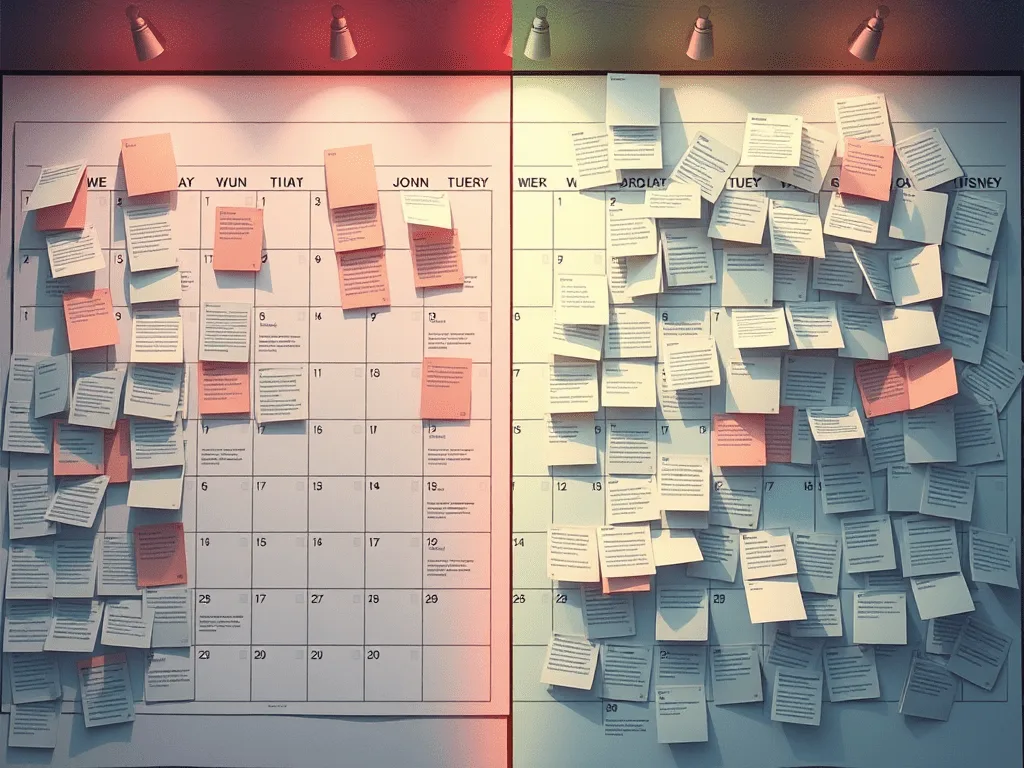
Calendars have stopped being tools and started being tyrants.
Digital calendars have been part of my world for decades. I don’t remember exactly when this happened. Likely, it was a long evolution. A meeting request here, a recurring sync with someone there, and eventually the blank spaces on your calendar belongs to everyone except you. The empty hour that might have been your best thinking time gets colonized by someone else’s agenda.
What’s striking about this pattern isn’t that it happens. It’s how rarely anyone questions it. The implicit assumption in most workplaces is that an open calendar slot equals availability—that if you haven’t blocked the time, it’s fair game. And since most of us never block time for thinking, creating, or recovering, the time never gets protected.
The result is a kind of slow-motion surrender. Your calendar becomes a ledger of what happened to you rather than a design of what you intended.
The recording trap

Here’s the distinction that changed how I think about this:
A ledger is retrospective. It records transactions after they occur. When you treat your calendar like a ledger, you’re essentially documenting commitments as they arrive—accepting meetings, noting appointments, and then looking back at your week wondering where it all went. The calendar becomes a historical record of how other people chose to spend your time.
A budget is prospective. It’s a plan for allocation before the spending occurs. When you treat your calendar like a budget, you’re deciding in advance how your hours will be distributed. You’re acknowledging that time, like money, is finite—and that every “yes” to one thing is an implicit “no” to everything else competing for that slot.
The research on this is surprisingly clear. A meta-analysis of 158 studies found that time management practices have a moderate effect on job performance, but a strong effect on wellbeing. The study found that the feeling of being in control of your time predicted wellbeing better than any actual productivity gains. In other words: the psychological benefit of designing your time outweighs the efficiency benefit.
Which raises a question worth sitting with: If control matters more than optimization, why do most of us cede that control so easily?
The loud work problem
Part of the answer is structural. The work that creates the most long-term value is almost always quieter than the work that demands immediate attention.
Loud work announces itself. Meeting invites that fill your inbox. Slack messages with red notification badges. Emails marked urgent (they rarely are). A colleague stopping by to “just ask a quick question” that somehow never is. These interruptions feel important because they’re present—they’re right in front of you, demanding response. They have advocates. They have deadlines. They have people who will notice if you don’t show up.
Quiet work waits patiently. Strategic planning. Deep analysis. Creative problem-solving. Learning something that will matter in six months. This work rarely sends notifications. It doesn’t have a lobby. It sits in the background, perpetually deprioritized by whatever is shouting at the moment.
Researchers at UC Irvine found that the average knowledge worker is interrupted or switches tasks every three minutes. Worse, it takes an average of 23 minutes to return to the original task after an interruption. The math is brutal: if you’re interrupted four times in an hour, you may never actually get back to what you were doing.
And here’s the uncomfortable finding from that same research: about 44% of those interruptions are self-initiated. We don’t just let others fragment our attention—we help them do it.
This is where the ledger mindset becomes self-reinforcing. When your calendar is reactive, your attention becomes reactive. When your attention is reactive, you start seeking interruptions because they’re easier than sustained focus. The meetings feel productive because at least something is happening, even if what’s happening is mostly you sitting in a room (virtual or otherwise) while someone shares their screen.

The cost of the open calendar
The American Psychological Association’s research on task-switching estimates that toggling between tasks can consume up to 40% of productive time. Not 40% of time spent switching—40% of productive capacity, lost to the cognitive overhead of constantly reorienting.
A study across 76 companies in 50+ countries found that organizations implementing meeting-free days saw productivity increase by 73% when employees had three meeting-free days per week. Autonomy increased 52%. Stress decreased 57%. And perhaps most surprisingly, cooperation improved by 42%—suggesting that fewer meetings doesn’t mean less collaboration, just less performative collaboration.
These aren’t marginal gains. This is the difference between a week that drains you and a week that builds something.
But here’s the catch: you probably can’t mandate meeting-free days in your organization. You may not control your company’s culture. You may work for people who equate availability with commitment, or who schedule “quick syncs” the way some people breathe—automatically and often.
So what do you actually control?
Designing your time (despite everything)
The shift from recording to designing starts with a different question. Instead of asking “what’s on my calendar?” you might try asking “what should be on my calendar before anyone else fills it?”
This is time blocking, but not the obsessive version where you schedule every fifteen-minute increment. It’s the protective version: identifying the work that matters most to you and giving it a home first, before the loud work can claim the space.
The pre-commitment move
At the start of each week—before opening email, before checking Slack—look at your calendar and ask: What are the two or three things I most need to accomplish this week, and when will I actually do them?
Block that time. Not as a suggestion to yourself, but as an appointment. When someone tries to schedule over it, your calendar shows a conflict. “I have a conflict at that time” is a complete sentence. No elaboration required.
The research supports this. Cal Newport’s work on deep work documents how the most productive knowledge workers treat focused time as non-negotiable—not because they’re antisocial, but because they’ve learned that fragmented attention produces fragmented results.
The buffer strategy
Meetings have hidden costs. There’s the meeting itself, but there’s also the context-switching before and after, the mental preparation, and the recovery time if the meeting was particularly draining.
One pattern I’ve found useful: never schedule meetings back-to-back. Build in buffer time—even fifteen minutes—between commitments. This isn’t slack time; it’s processing time. It’s the space where you capture notes, clear your head, and actually think about what just happened before rushing into what’s next.
Without buffers, you’ll be quickly drained and feel easily overwhelmed. Build it in and you will quickly start feeling the benefits. It won’t take long before seeking the relief of those buffers becomes a habit you’ll always try to feed.
The question before the accept
Before accepting any meeting invitation, try asking yourself a few questions:
- Is my presence actually necessary, or am I being included out of courtesy?
- Could this be handled asynchronously—via email, document, or recorded video?
- What would happen if I didn’t attend?
That last question is more useful than it sounds. Many meetings continue out of habit rather than necessity. Your absence might not matter as much as you assume—or it might surface that the meeting itself isn’t necessary.
If you’re not comfortable declining outright, softer alternatives exist:
- “Can you send me a summary instead? I’ll review and follow up if I have questions.”
- “Is there a specific decision you need from me? I could provide that asynchronously.”
- “Would a 15-minute call accomplish the same thing?”
These aren’t excuses to be unhelpful. They’re invitations for others to consider whether a meeting is truly the most efficient path forward—for everyone involved.
The multiple calendar layer
One approach that’s changed how I think about protection: maintaining separate calendars for different purposes, then layering them together.
A work calendar that others can see. A personal calendar that’s private. A “focus time” calendar where you block periods for deep work. When you view them overlaid, you see the complete picture. When you share with colleagues, they only see what’s relevant to them—but your protected time remains protected. If your calendar tool is capable, color-code each calendar to get an even more powerful perspective of the tyranny over your time.
The sophistication isn’t in the technology. Most calendar apps support this. The sophistication is in the mental shift: treating your time as something you design, not something you document.
The culture problem

It would be dishonest to pretend that individual tactics solve everything. If you work in an environment where leadership schedules wall-to-wall meetings, where declining an invitation signals lack of commitment, where “face time” matters more than output—the strategies above become harder to implement.
Culture flows downhill. Research on workplace availability norms found that perceived expectations of constant availability predict burnout, even if actual demands don’t change. It’s not just what your organization does that affects you—it’s what you believe they expect.
But here’s what’s worth noting: even in difficult cultures, there’s usually more room than you assume. Most people overestimate how much pushback they’ll get for protecting their time. A blocked calendar slot that says “Focus Time” is rarely questioned as it looks like work. Declining a meeting politely, with an offer to help asynchronously, rarely damages relationships.
The goal isn’t to opt out of collaboration. It’s to be intentional about which collaboration deserves synchronous time and which doesn’t.
What the research suggests
The accumulated evidence points in a consistent direction:
- Time autonomy matters more than time optimization. Feeling in control of your time predicts wellbeing better than actually being efficient. [1]
- Interruptions have compounding costs. Each context switch taxes cognitive capacity, and the costs accumulate across the day. [2] [3]
- Meeting load correlates with fatigue. As meetings increase, wellbeing decreases—even controlling for total hours worked. [4]
- Fewer meetings can mean better collaboration. Organizations that reduce meeting time often see communication and cooperation improve as people find asynchronous alternatives. [5]
None of this research prescribes a specific system. It just describes what happens when you record your time versus design it.
Worth questioning
I keep returning to is how normalized the recording (instead of budgeting) mindset has become. Most people don’t choose to let their calendars happen to them—they just never considered the alternative. The meeting invite arrives, they accept, and another hour disappears.
What’s interesting is that this applies even to people who meticulously budget their money. The same person who tracks every dollar and refuses impulse purchases will accept every meeting request without a second thought. Time is arguably more finite than money—you can always earn more money—but we protect it far less carefully.
Maybe that’s because time feels renewable in a way money doesn’t. There’s always tomorrow, always next week. Until there isn’t.
Can we think different?
- If you mapped your ideal week against your actual week, how big would the gap be?
- What would happen if you treated one hour tomorrow as non-negotiable—blocked before anything else could claim it?
- Which recurring meetings on your calendar have you never actually questioned?
Selected References
- Aeon, B., Faber, A., & Panaccio, A. (2021). Does time management work? A meta-analysis. PLOS One. Link
- Mark, G., Gonzalez, V. M., & Harris, J. (2005). No task left behind? Examining the nature of fragmented work. ACM CHI 2005. Link
- American Psychological Association. Multitasking: Switching costs. APA Topics. Link
- Luong, A., & Rogelberg, S. G. (2005). Meetings and more meetings: The relationship between meeting load and the daily well-being of employees. Group Dynamics: Theory, Research, and Practice. Link
- Laker, B., Pereira, V., Budhwar, P., & Malik, A. (2022). The surprising impact of meeting-free days. MIT Sloan Management Review. Link
- Newport, C. Deep habits: The importance of planning every minute of your work day. Cal Newport Blog. Link
- Hendrikx, K., Van Ruysseveldt, J., Proost, K., & van der Lee, S. (2023). “Out of office”: Availability norms and feeling burned out during the COVID-19 pandemic. Frontiers in Psychology. Link
How does this shift your thinking? Share your perspective!