

Most work nights feel like the last one. I climb into the car, start a podcast—because I am determined to always be learning—and pull out of the parking lot at work. Within a few minutes, the podcast fades into background noise. My mind has already left the episode and is replaying the last eight to ten hours.
I also see all the things I intended to accomplish and never touched.

What it recalls is not a clean list of meaningful accomplishments. Instead, it is a massive multitude of minor things.
The reply to a customer about a quote, or a team member about some task that needed clarity. An online chat about a ticket that “just needs a quick look.” A meeting that ran long. An email I opened but did not answer because something more urgent appeared. A document I meant to review but only skimmed. A decision that should have taken 10 focused minutes but which got stretched out because of five different interruptions and which still does not feel solid.
Most days there is also a string of moments when someone walks into my office or pings me with something that “can’t wait” because I am the only person with the history, the context, the documentation, or the authority to answer it. A technical matter needs to be explained, a project needs to be unblocked, a question needs to be answered. Those conversations matter.
By the time I am partway home, the thinking has left me feeling unaccomplished. I have been in motion all day, but I am not sure what, exactly, I finished.
That is usually when I realize I have not heard a word of the podcast and need to rewind five, ten, or more minutes to regroup with it. Sometimes I do that two or three times on the same forty‑minute drive.
This article is about that feeling.
When your brain runs thirty (or more) browser windows at once

We use plenty of casual terms for what is happening here. We call it multitasking, distraction, overload, or “just our busy time of the year.” Yet none of those adequately capture the pattern.
Researchers have a name for this: attention fragmentation. I think it fits.
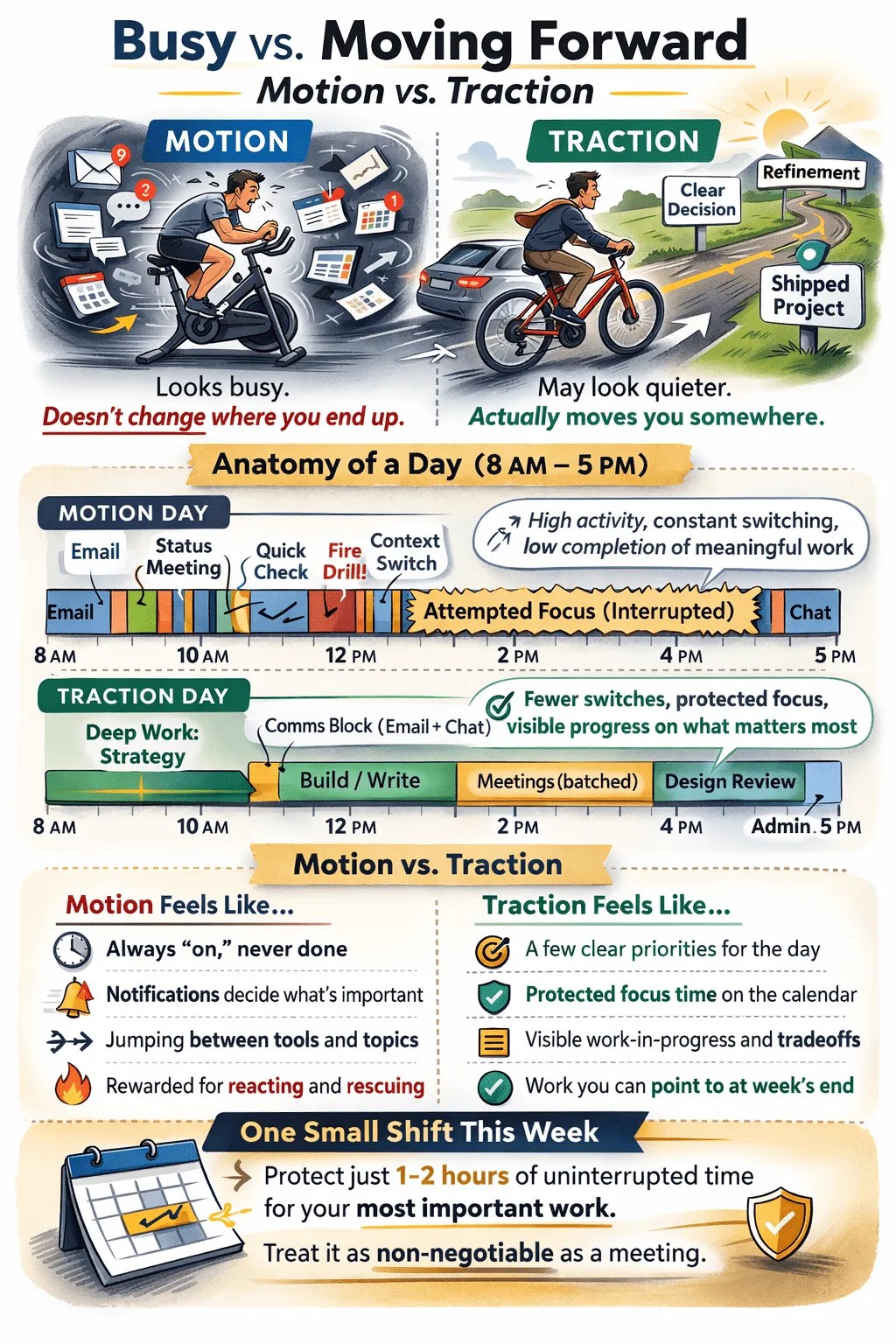
Attention fragmentation is what happens when your day is broken into constant, small shifts of focus across tasks, channels, and people. It is not a single big interruption. It is the cumulative effect of:
- Rapid task and context switching: moving from writing to chat to tickets to email to a meeting and back again, rarely staying with any one thing long enough to feel fully inside it.
- Notification‑driven micro‑interruptions: pings and pop‑ups that pull your eyes and thoughts away, even when you do not consciously respond.
- Self‑initiated checks: “I will just see if they replied,” “I should see how that ticket is going,” or “I will clear a few emails so I do not fall behind,” which quietly slice up your own focus.
This all looks very productive. I am responsive. I am available. I am informed. My calendar is full, my inbox is active, and my chat history is impressive.
Yet underneath and out of view, there is a growing gap between feeling busy and making progress.
Busy is motion. Progress is traction. Attention fragmentation maximizes motion and quietly erodes traction. You end up with days full of activities (motion) and weeks that do not add up to the work you thought you were doing (traction).
How modern work manufactures fragmentation
It is tempting to treat the lack of traction as a personal failing: if I were more disciplined, my inbox would not be a disaster, my calendar would not be a minefield, and my focus would be stronger.
There are places where personal habits matter. But the more I think about this, the more I see something different. And the more I think, the harder it is to keep owning this as a willpower problem.
My modern knowledge‑work environment—probably a lot like yours—almost seems custom‑built to fragment attention.
The digital environment
We run our days across a stack of tools: email, chat, ticketing systems, shared documents, dashboards, specialized apps, calendars, notes, text messages, and more. All of them are capable of interrupting us. Most ship with default‑on notifications and “smart” badges specifically designed to capture our attention and pull us back in.
Work is increasingly distributed across these surfaces. You cannot “just ignore email for a while” when key approvals live there, status updates live in chat, and customer issues live in a ticketing queue.
The cultural environment
Our culture seems to have shifted to a place where responsiveness has became a proxy for commitment. If you are quick to answer, you are engaged. If you are slow, you are suspect. If you disappear for a few hours to think, you are a problem.
Teams develop informal availability norms: messages sent after hours still get answered, “just a quick question” always jumps the queue, and fast responders get praised. Meetings, chats, and side conversations quietly become the real operating system of the organization.
The written plan says we will prioritize deep, strategic work. The lived reality is that we prioritize whatever pings us next.
The structural environment
Very few organizations have any meaningful way to see how much work is actually loaded onto each person at a given time. New projects, requests, and “can you just” items are assigned based on who is present, who is good, and who is least likely to say no—not based on capacity.
High performers become magnets for extra work. The better you are at juggling, the more balls people throw at you and the more hats you have to wear.
Put this together and fragmentation stops looking like a character flaw; it starts looking like an emergent property of how we have designed work.
What constant context switching does to your brain and your work

When you switch away from a task, it does not vanish from your mind. A part of your attention stays with it, holding onto loose ends and unresolved questions. Once you become aware of this fact, you’ll actually start recognizing it as it happens to you. You’re working on that next thing, but your brain has drifted back to the previous thing. Back and forth it goes.
A recent systematic review of interruption research argues that modern work is characterized by a dense mix of external interruptions and self‑interruptions that continually pull attention away from whatever you were just doing.
Multiply that by dozens of switches across a day and you are asking your brain to carry a ridiculous amount of unfinished context at once.
The costs show up in a few places.
Cognitive load and error risk
Every switch forces your working memory to drop one set of details and load another. That loading and unloading takes effort.
As the number of partially active tasks grows, so does the chance you forget something important, misremember a detail, or misjudge a decision because you are not fully inside the problem when you act.
Depth and decision quality
Some work is fine in fragments: scheduling a meeting, approving a small purchase, or answering a straightforward question.
Other work—designing a deliverable, writing a proposal, thinking through downstream consequences—requires continuity. You need time to assemble context, test ideas, and feel your way to a coherent conclusion.
Fragmentation nudges everything toward shallow work. You tackle complex problems in slices, making small, local fixes without ever holding the whole picture in your head.
Your experience of yourself
Over time, you start to feel permanently behind. There is always another message you have not answered, another document you have not read, another request you have not acknowledged. The gap between what you know you are capable of and what you are actually delivering widens. You know what your best work feels like. You also know you are not getting there very often.
On paper, constant context switching lets you move faster. In practice, it often trades long‑term quality, sustainability, and satisfaction for the appearance of speed.
The eventual result is a specific kind of grief: not about losing your job or your role, but about losing contact with your own competence.
When organizations refuse to look at capacity
If you ask most organizations, they will tell you they care about well‑being and sustainable workload. If you look at how work is actually assigned, a different story appears.
The uncomfortable truth is that many teams have no shared, reliable way to see capacity.
- With fragmented systems, there is no single place where you can see all of the projects, tickets, and responsibilities currently sitting on a person’s plate.
- There is no agreed‑upon sense of what “full” looks like for a given role.
- Before assigning something new, there is no routine practice of asking, “What are we going to take off this person’s plate to make room?”
In that vacuum, leaders and colleagues rely on proxies:
- “You are really good at this, can you take it?”
- “You seem responsive; you are clearly on top of things.”
- “You did this last time, so you should probably own it again.”
The result is predictable.
- The people who are most capable and most conscientious accumulate the heaviest, most fragmented workloads.
- New urgent items land on whoever is visible and reliable, regardless of what else they are carrying.
- Important but non‑urgent work gets perpetually delayed, because there is never any slack to get it done.
From the outside, this looks like a heroic culture of “stepping up.” From the inside, it feels like constantly running beyond your actual capacity while pretending that everything is fine.

Why you feel like you are failing (when the system is)
If you live in this environment long enough, it is easy to start telling yourself a particular story:
- “I should be able to handle this. Other people seem to be managing.”
- “If I were more organized, my inbox would not be such a mess.”
- “If I were younger, I’d have enough energy to handle this.”
- “If I were older, I’d probably know how to juggle this better.”
- “If I were more disciplined, I would not let myself get distracted so easily.”
There is always some truth in personal responsibility. We all have habits we can improve and avenues we individually uncover to be more efficient. But if that is the only story we tell, we ignore what the system itself is doing to our attention.
It is hard to feel calm and competent when:
- The organization’s stated priorities do not match the actual operating rhythm of meetings, messages, and fire drills.
- Reward structures praise visible responsiveness more than thoughtful outcomes.
- Tools and processes are layered on top of one another without any serious attempt to simplify or remove.
In that context, feeling scattered is not evidence that you are weak. It is evidence that your attention is behaving exactly the way attention behaves in a noisy, overloaded system.
The shift that matters is not from “I am failing” to “I am a helpless victim.” It is from “I am failing” to “the issue is my work environment, not who I am.”
Experiments for reclaiming focused time (within imperfect systems)
Most of us do not have the power to redesign our organizations. We do, however, have the power to experiment with our own path through the workday. That will not change things overnight. But over time, we can carve out small, durable patches of focus in the middle of a noisy reality.
Personal experiments
- Protect a small block of deep‑work time. Start embarrassingly small if you have to—thirty minutes, twice a week, where you deliberately turn off notifications and focus on one meaningful task.
- Create a “notification diet.” Decide which channels truly need to be allowed to interrupt you in real time, and which can be checked on a schedule. Then actually change the settings.
- Limit your concurrent “big things.” You may not be able to change your official project list, but you can choose one or two pieces of meaningful work to treat as “today’s real priorities,” and let your calendar reflect that.
Relational experiments with your team and manager
- Make work‑in‑progress visible. Even a simple shared board or list that shows what you are actually working on can change the conversation from “can you take this?” to “what are we going to swap out?”
- Set channel expectations. Agree on what “urgent” means, which channel is for actual emergencies, and what a reasonable response time looks like for everything else—with your team, your manager, and even your customers.
- Protect shared focus windows. Experiment with a few hours each week where the team treats meetings and non‑critical pings as off‑limits by default so everyone has a chance to reduce fragmentation, not just you.
Organizational levers (even from the middle)
You may not be the one holding the org chart, but you can still influence the decisions leaders make. Put some questions on the table during conversations and meetings to trigger fragmentation-related thinking:
- “Where in our week do we expect people to do uninterrupted thinking?”
- “How do we know when a team or person is at capacity?”
- And my personal favorite: “What are we willing to stop doing in order to do the most important work well?”
Questions like those may be just enough to loosen the assumption that endless fragmentation is simply “how things are.”
Worth questioning
If attention fragmentation has become as normal as the cubicles we work in, a few beliefs deserve to be held up to some different thinking:
- That responsiveness is the same thing as results.
- That the person juggling the most work is the one we should admire most.
- That tools and automations can fix the fragmentation created by how we load and route work.
- That busy is progress.
I am paying more attention lately to the moments when I am tempted to say “yes” out of reflex or obligation, or to check one more channel before I leave for the day. Those are early signals that my attention is once again being sliced thinner than I intended.
So now before I start the podcast in my car and make the drive home, I question whether I moved the organization forward in some way today. Reducing the fragmentation of my day has allowed me to see that answer more clearly. And far more often that answer is “yes”.
Can we think different?
If you recognize yourself in any of this, a few questions might be worth carrying into your own commute home:
- Where does your attention actually go in a typical week, and how closely does that match what you say matters most?
- What would have to change—for you, your team, or your organization—for deep work to be normal rather than exceptional?
- If you stopped treating your fragmentation and exhaustion as a personal failure, what patterns in your environment would become easier to see?
You may not be able to rebuild the whole system you work in. But you do have choices about how you spend your attention inside it. Those choices, made quietly and consistently, are where the work of thinking different really begins.
Selected References
- Stangl, F. J., & Riedl, R. (2023). Interruption science as a research field: Towards a taxonomy of interruptions as a foundation for the field. Frontiers in Psychology. Open-access PDF
- Mark, G., Gudith, D., & Klocke, U. (2008). The cost of interrupted work: More speed and stress. Proceedings of CHI 2008. Conference paper PDF
- Chen, A., & Karahanna, E. (2018). Life interrupted: The effects of technology-mediated work interruptions on work and nonwork outcomes. MIS Quarterly, 42(4), 1023–1042. Author-hosted PDF
- Reinke, K., & Chamorro-Premuzic, T. (2016). When email use gets out of control: Understanding the relationship between email overload and employee well-being. The Psychologist. Article
- Mark, G., Iqbal, S. T., Czerwinski, M., Johns, P., & Sano, A. (2016). Email duration, batching and self-interruption: Patterns of email use on productivity and stress. Proceedings of CHI 2016. Conference paper PDF
How does this shift your thinking? Share your perspective!